An Ecological-Economic Framework of Alternative Forest Management in the Southern Appalachian Region
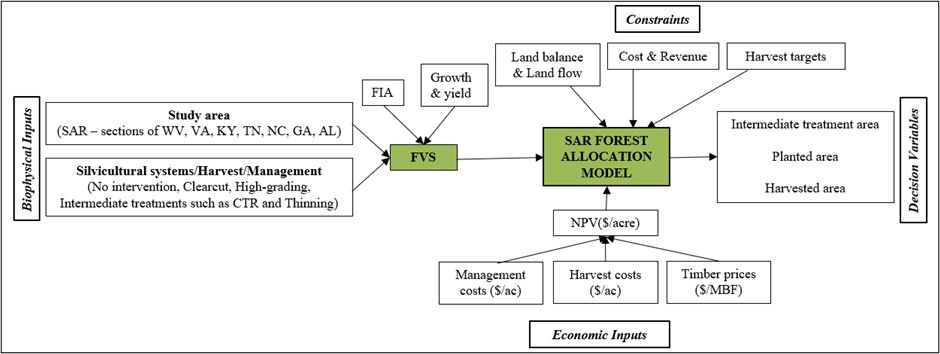
This project aims to refine forest sector models by building an ecological-economic framework that simulates detailed landscape-scale management interventions in complex hardwood forests of the southern Appalachia. In my current capacity as an ORISE fellow, I am building an economic optimization model of hardwood systems and analyzing simulation modeling results to assess interactions between market dynamics, environmental change, and management interventions, including assessing new and emerging markets for biochar on the resource base and rural economy in southern Appalachia.
Economics of Potential Alternative Oak Management Practice in the Southern Appalachia
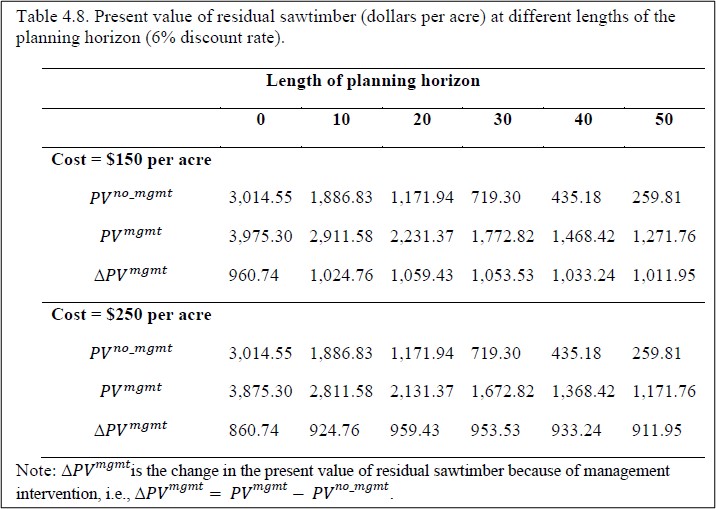
To examine the economics of the potential management intervention for improved oak management at a landscape level, we simulate a hypothetical management intervention in mixed oak forests in the southern Appalachia section of North Carolina. Specifically, we use Forest Inventory and Analysis (FIA) conditions and tree data in Forest Vegetation Simulator (FVS) to simulate two alternative management scenarios: a) no management, and b) management i.e., removal of prolific oak competitors. Results indicate that the management intervention has the potential to enhance the timber value of stands by promoting growth of oaks, generate higher benefits, and counteract mesophication of oak forests. Additionally, the change in present value of residual sawtimber attributed to management intervention is positive throughout the projection horizon and is highest in the next 20-30 years.
Dissertation (Chapter 4): https://www.lib.ncsu.edu/resolver/1840.20/45570
Management, Markets, and Mesophication: An Empirical Exploration of Oak Forests in the Southeastern US
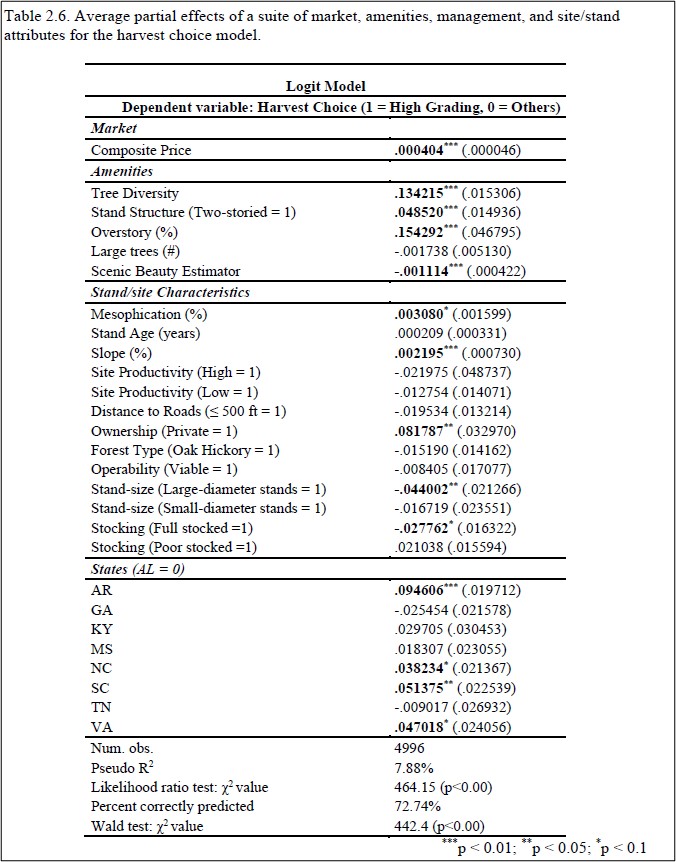
This paper primarily uses the Forest Inventory and Analysis (FIA) database to perform an empirical analysis that: a) examines the role of exploitative high-grading harvest practice in driving mesophication; and b) assesses on-site characteristics (including amenities) and market signal (price) driving the choice of harvest practice in oak forests of the Southeastern US. We use results from this empirical analysis to estimate willingness-to-accept (WTA) compensation for forest landowners to forgo high-grading to reduce mesophication transitions. Our analysis shows that high-grading has a significant and positive association with mesophication on harvested sites. Further, the random utility-based harvest choice model reveals that amenities and timber outputs have a complementary effect on the choice of high-grading; we estimate the willingness-to-accept (WTA) value at $7.62 per thousand board feet, or $9.23 per acre on average across the region.
Preprint: https://dx.doi.org/10.2139/ssrn.5166393