Physical Presence, Practical Absence: Accessibility of Timber Inventory in the Eastern US
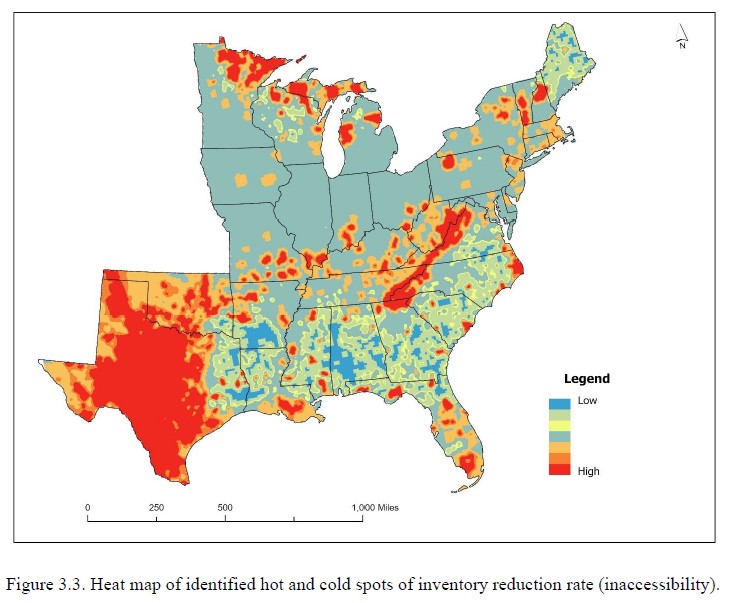
We employ a mix of regression and spatial analysis to estimate and visualize timber and carbon accessibility on eastern forest land in the US – and how species-specific estimates vary, in our case, white oak. The logistic regression shows that all seven biophysical and social characteristics, i.e., site physiography, productivity, slope, road distance, amenity value, ownership, and past harvest experience, significantly explain the lack of harvest/management decisions on forested lands in the eastern US. The subsequent spatial analysis illustrates that the higher timber accessibility spots/timber basins are mostly concentrated in the coastal Atlantic plains, gulf coast of the Southeast, and most of Maine, whereas the lower timber accessibility spots/timber basins are largely concentrated along the mountainous region of the Appalachia, the Ozarks, Ouachita, parts of the upper Midwest, and drier parts of west Texas.
Full paper: https://doi.org/10.1016/j.tfp.2026.101155
Spatial Expansion of the Subregional Timber Supply (SRTS) Model to the Central Hardwood Forest Region
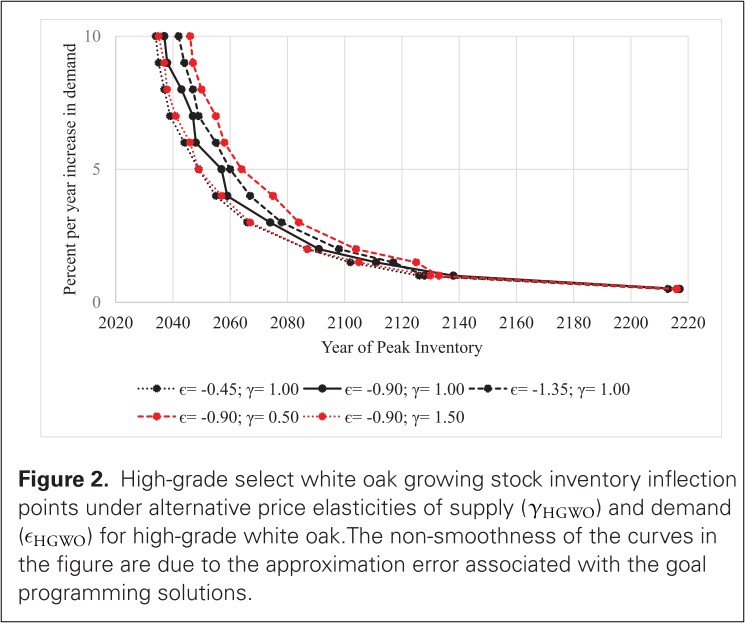
We examined the importance of market demand parameters, including growth rates for product demand and supply/demand elasticities, in influencing future inventory trajectories of high-grade white oak timber in different subregions over the projection horizon. Results of this study indicate that more elastic demand and more inelastic supply response concomitantly defer the time before the inventory culminates.
Full paper: https://doi.org/10.1093/jofore/fvad005
Economy-wide Impacts of Projected White Oak Timber Supply in Kentucky: A CGE Model Analysis
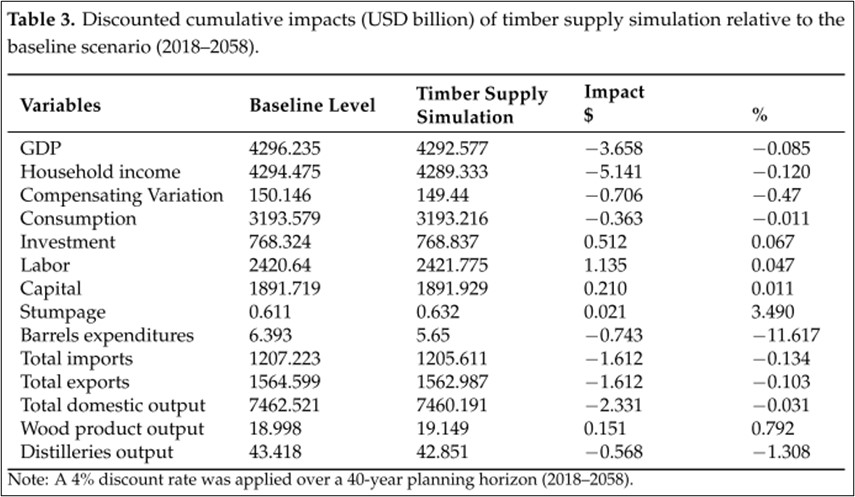
We use a dynamic computable general equilibrium (CGE) model to assess the potential economic impacts of the projected white oak timber supply following an overall increased supply of white oak sawlogs but reduced supply of high-quality white oak sawlogs in Kentucky. Results generated from a dynamic computable general equilibrium (CGE) model indicate a cumulative present-value GDP reduction of USD 3.66 billion, a USD 0.71 billion decline in consumer welfare, and other sectoral contractions over 40 years (2018–2058).
Full paper: https://doi.org/10.3390/f15010093
A 50-year Outlook of White Oak Inventory in Kentucky
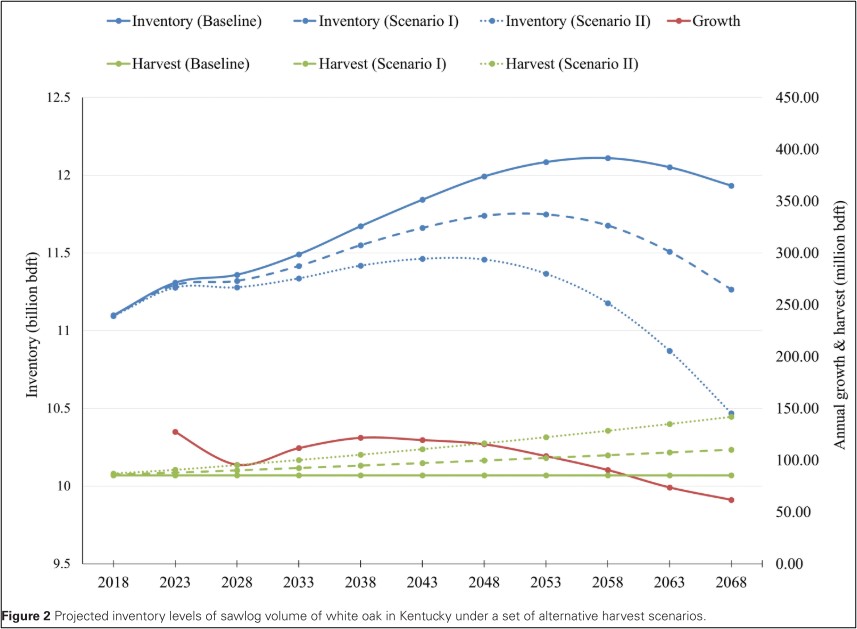
Using Forest Inventory and Analysis (FIA) data together with the Forest Vegetation Simulator (FVS), we performed a base run analysis of projected inventory levels of white oak sawlogs to better understand whether the inventory level is sustainable to support the current harvest level of white oak in the future. The projections were further examined by tree grades to provide a general outlook on the quality of white oak timber growing in Kentucky’s forests in posterity. By doing so, we generated results that indicate that projected inventory levels of white oak sawlogs cannot be considered sustainable to support current harvest levels from 2058 onwards. In addition, the long-term trends in inventory levels of high-quality white oak sawlogs would be continuously declining whereas that of low-quality sawlogs would be steadily increasing.
Full paper: https://doi.org/10.1093/jofore/fvad041